
Begin a Tuscaloosa Residents Search
A useful Tuscaloosa residents directory search starts with the strongest known fact. A current street address points first to the county parcel roll. A full name can be checked in property, deed, court, probate, voter, or business records. An older address belongs in city directories, census schedules, newspapers, and maps. These sources identify different groups, so no single result should be treated as a full household list.
The source date matters as much as the name. A deed proves a legal transfer on its recording date. A directory records a listed person in one issue year. A tax card identifies an assessed owner, while a voter record concerns registration. Renters, unlisted household members, and people who recently moved can be absent. Search in a short chain and keep each role separate.
- Search the county property roll by owner or physical address and save the parcel number.
- Compare the parcel's situs address with the owner's mailing address.
- Use the deed reference and Probate index to identify the parties and recording date.
- Check the proper court, voter, or vital-record channel only when it fits the question.
- Move to library directories, yearbooks, newspapers, and census sources for an older trail.
For a whole named road, the Tuscaloosa street directory workflow follows parcels in sequence. One-person research instead depends on two independent matches, such as the same middle initial plus a stable parcel, relative, case number, or business ID.
Tuscaloosa Resident Records Desks
Tuscaloosa resident records are split by legal function. The Probate Judge records deeds, mortgages, releases, plats, and other instruments, while Probate Court manages estates and related matters. The Tax Assessor ties names and mailing addresses to parcels. The Board of Registrars handles voter status and participation records. State trial cases belong to the Sixth Judicial Circuit and its clerk, not the city court. Choosing the custodian first saves time and helps preserve the meaning of each result.
Tuscaloosa County Probate
714 Greensboro Avenue, Room 121
Tuscaloosa, AL 35401
205-464-8206
Tuscaloosa County Mapping
714 Greensboro Avenue
Tuscaloosa, AL 35401
205-464-8393
Tuscaloosa Board of Registrars
2501 7th Street, Suite 200
Tuscaloosa, AL 35401-1891
205-464-8415
The county's Probate landing page shows the separate records and court routes. The captured office page below is a practical starting point, but the record itself remains with its named custodian.
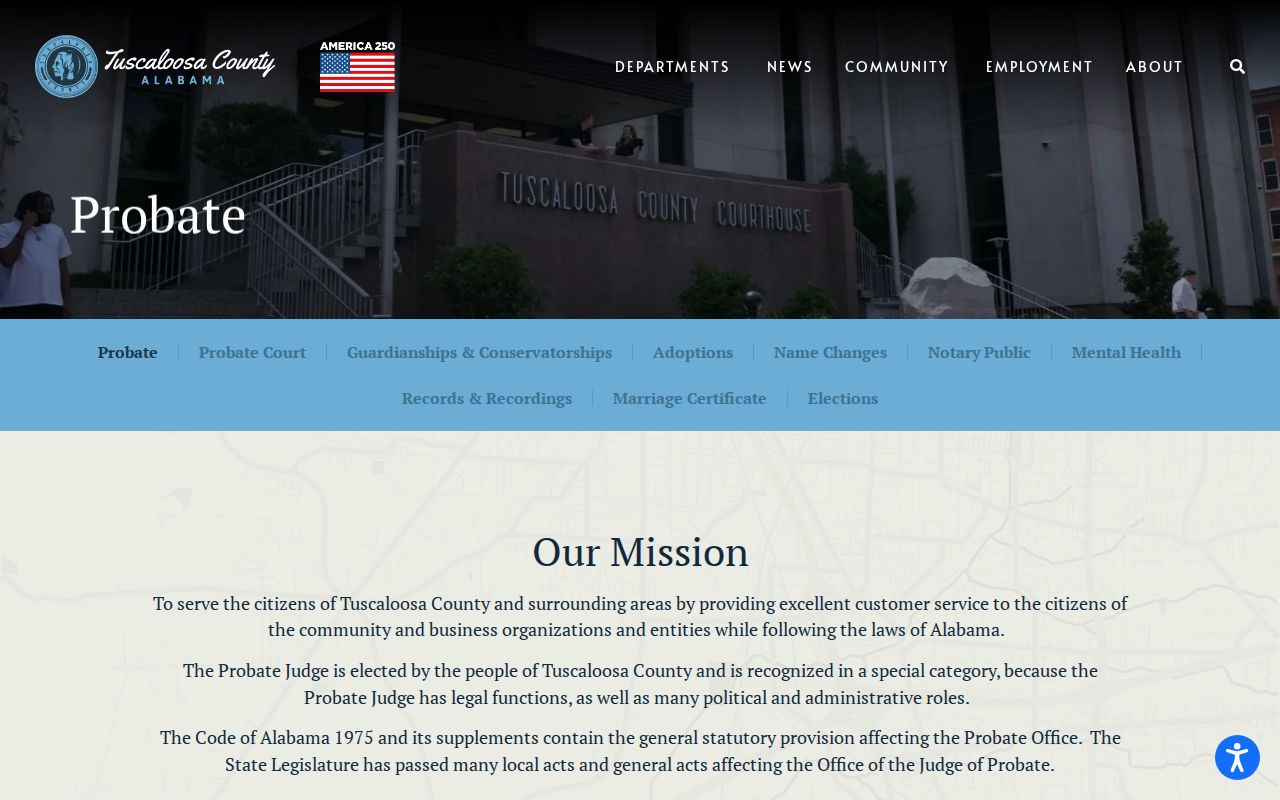
The Probate route is best for recorded instruments and estates; ownership maps, trial cases, and voter files must still be taken to their own keepers.
Tuscaloosa Property Lookup Fields
The county's free Public GIS/CAMA search is the most direct bridge from a Tuscaloosa name or address to a parcel. CAMA means computer-assisted mass appraisal. It is the assessor's working property inventory, not proof of who sleeps at an address. A broad query returns no more than 100 results, so add a street number, district, or subdivision when a surname produces too much noise.
| Search control | Format | Best use |
|---|---|---|
| Owner | Last First Middle; Begins with or Contains | Find assessed parcels tied to a name |
| Physical address | Number and street name | Locate the parcel at a known site |
| Parcel Pin or Account | Up to eight digits; omit leading zeroes | Reopen an exact property |
| District | Named tax district | Separate Tuscaloosa from county and nearby cities |
| Subdivision | Dropdown inventory | Constrain a neighborhood or recorded plat |
The Tuscaloosa Public GIS/CAMA form also accepts acreage and value ranges and can export a constrained result to Excel.
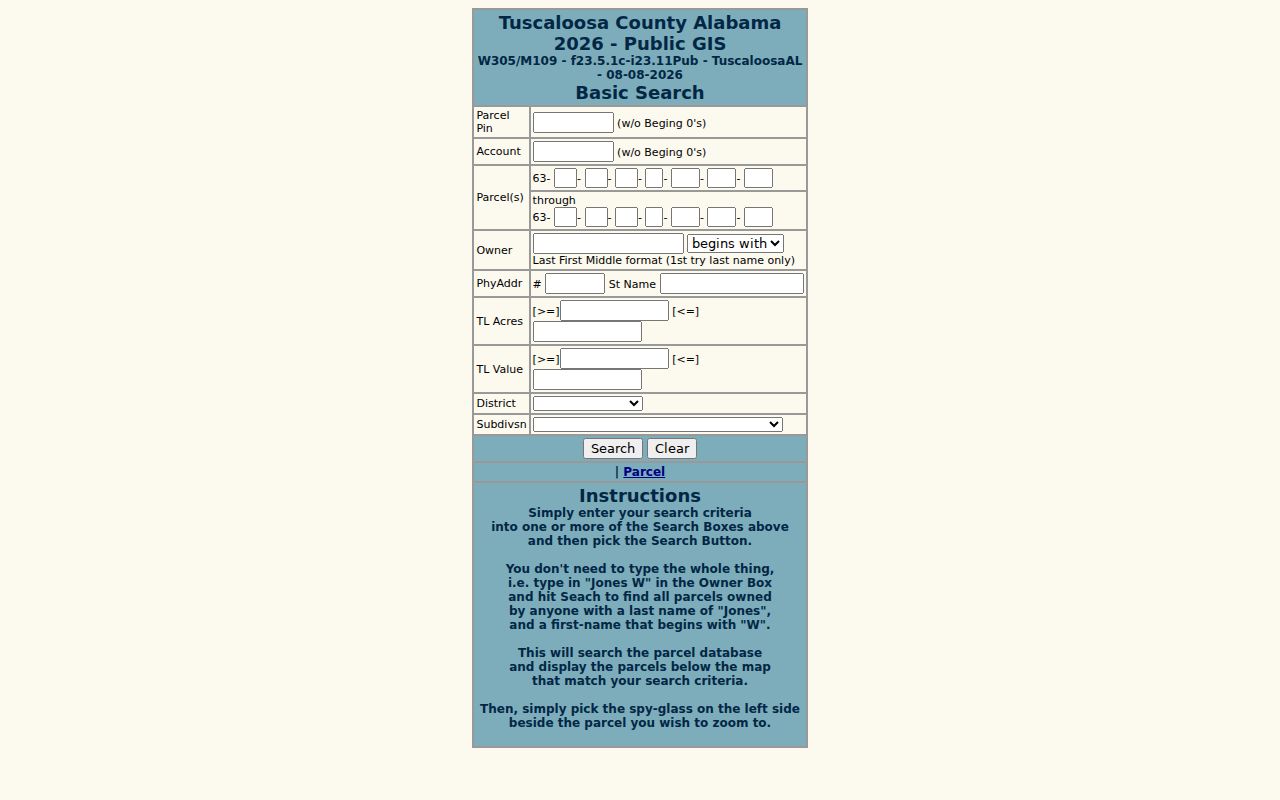
Results separate parcel address from owner mailing city, state, and ZIP. That distinction can signal an owner who receives mail elsewhere, but it never proves who currently occupies the parcel.
Current Tuscaloosa Resident Rolls
Current Tuscaloosa directory sources are official lists made for a defined public task. None is a general census of all residents. Their strength is precision: a parcel roll identifies assessed ownership, a deed index identifies parties to an instrument, and a court index identifies parties in a case. The weakest approach is to merge those roles into one assumed identity.
| Official source | People included | What it can establish | Access |
|---|---|---|---|
| Property roll | Assessed owners | Owner, situs, mailing address, parcel, value | Free online search |
| Probate index | Parties to recorded instruments and estates | Legal role, date, record reference | Free account view; copies vary |
| Voter system | Registered voters | Status, residence geography, participation fields | Self-lookup or paid statutory file |
| Court records | Named case parties | Role, case type, docket events | Paid portal or clerk request |
| Business and license indexes | Filed agents, officers, or licensees | Dated professional or entity link | Agency search or request |
Commercial people-finding tools compile many feeds and may join people who share a name. Official rolls are narrower but reveal their custodian, purpose, and record date. Use a commercial compilation only as an unverified lead, then return to the official Tuscaloosa residents directory trail.
Census QuickFacts reports a 42.9% owner-occupied rate and only 72.3% of residents living in the same house as one year earlier during the cited survey period. Those local measures explain why an owner roll or one dated profile cannot stand in for all current residents.
Tuscaloosa Probate Name Index
Tuscaloosa County's ordinary online name search covers March 20, 1975 forward. After accepting the terms, a user creates a free account and searches names as Last Name First Name without punctuation. “Begins With” can narrow a known spelling, while “All Names” is useful when a person may appear in another indexed role. Search groups include Deeds, Judgments, and Probate Court.
Older work does not end at the portal cutoff. Choose Historical Indexes, select a dated book, then use the Direct index for a seller or grantor and the Reverse index for a buyer or grantee. A grantor transfers an interest; a grantee receives it. Preserve the book and page, instrument number, recording date, and legal description before following the next link in a deed chain.
The official Tuscaloosa County Probate gateway links the record search and fee information. A regular physical-book copy is listed at $1 per page, with certification adding $3. Certification must come from Probate; a portal print or tax map is not a certified record.
Tuscaloosa Court Lookup Routes
A court search must begin with jurisdiction. Tuscaloosa Municipal Court handles city ordinance violations, traffic cases, and certain misdemeanors. State circuit and district matters belong to the Sixth Judicial Circuit. Estates and guardianships belong to Probate Court. Federal matters are searched through PACER and the Northern District of Alabama. One portal does not cover all four paths.
Just One Look is Alabama's paid trial-court case service. Its account screen provides on-demand case details and documents, while an Alacourt subscription uses a separate login.
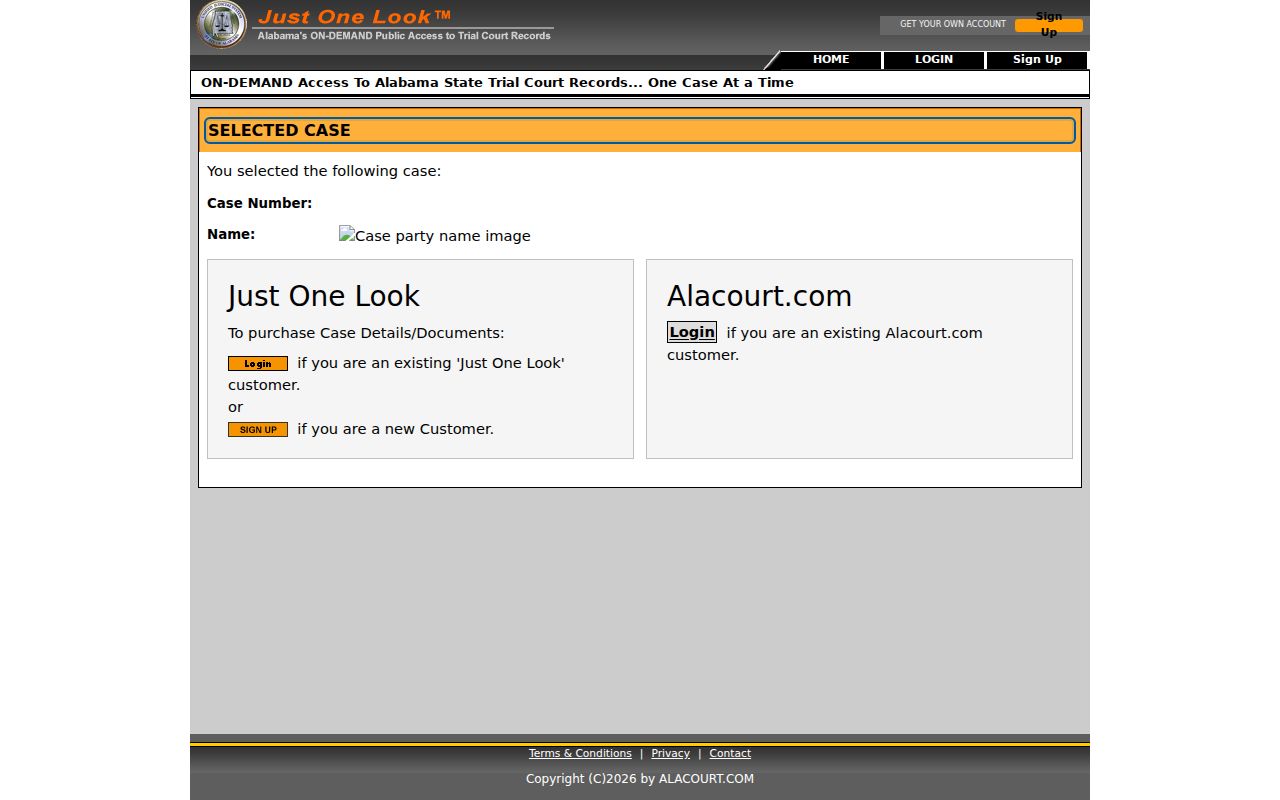
The screen is an index and purchase route, not the clerk's certified file. When an online entry is missing or unclear, the official copy-request form asks for the case number, party names, aliases or birth date where relevant, type or charges, exact documents, and certification choice. Sealed, expunged, juvenile, and adoption material stays unavailable.
Tuscaloosa Voter Record Limits
Alabama's My Voter Page is a self-service check for registration, ballot status, and polling place. It should not be presented as an open Tuscaloosa resident directory by street. The Board of Registrars can help with county registration questions, while a broader statutory voter list is requested from the state in a chosen county, city, or district scope.
An electronic list costs $0.01 per voter, and print costs $1 per page. Available selections include full name, status, residence, race, gender, several election districts, and up to ten elections in which a voter participated. Participation means that a ballot was cast in an election. It never reveals ballot choices, and Alabama does not register voters by party.
Inactive status is not proof that a person is ineligible or gone. Alabama's maintenance process sends notices and waits through statutory confirmation periods. A current answer should come from the Registrars, not an inference drawn from a label.
Tuscaloosa Vital Records Access
Vital certificates document an event and relationships, but Alabama does not offer a statewide public browse-by-name vital directory. The Department of Public Health issues births and deaths from 1908, marriages from August 1936, and divorce certificates from 1950. Earlier Tuscaloosa marriages return to Probate, while an earlier divorce or the full case file belongs with the Circuit Clerk.
Birth certificates remain confidential for 125 years and death certificates for 25 years. Marriage and divorce certificates are nonconfidential, subject to the agency's ordering rules. The first certified copy or search costs $15, same-order extras cost $6, and mail processing is estimated at seven to ten days. The first fee is nonrefundable even when no record is found.
The Alabama vital-records office explains eligibility and the official ordering channels.

A statistical divorce certificate and a court case file answer different questions. The certificate confirms the event; the clerk's file may contain pleadings and docket material that remain subject to court access and redaction rules.
Verify Tuscaloosa Resident Matches
Common names make a Tuscaloosa resident lookup easy to overread. First record the full name, middle initial, suffix, approximate age, and known geography. Next compare two stable facts from independent sources. A parcel number, legal description, spouse, business ID, case number, or a tight run of dates is stronger than a shared first and last name.
- Roll
- An official list created for a defined task, such as tax assessment or voter registration.
- Index
- A finding aid that points to a record; it may not show the full document.
- Parcel
- A mapped unit of land identified by an account, PPIN, or legal description.
- Criss-cross directory
- A directory arranged by street or telephone number rather than only by surname.
Roles must stay separate. A grantor is not a grantee. A registered agent's filing address is not automatically a home. A property owner may live elsewhere, and a court party may be a plaintiff, defendant, witness, or representative. Keep contradictory facts instead of forcing two records into one person.
Tuscaloosa Library Directory Routine
The Tuscaloosa Public Library's Main Library is the best local fallback when web indexes stop. Researchers sign in at the second-floor Reference Desk for Archives and microfiche access. Genealogy computers require a separate code from staff. The collection expressly includes Tuscaloosa and Northport city directories, local yearbooks, the Tuscaloosa News, cemetery and funeral records, census works, church material, tax sources, family histories, and maps.
The library Archives and Genealogy page outlines the on-site collections and database access.

Ancestry Library Edition is available in the library. HeritageQuest and the library's FamilySearch affiliate access add census, vital, court, directory, and map sources. Ask staff to confirm exact item years because the public holdings page names some formats without claiming an unbroken run.
Yearbooks provide a lawful former-classmate route. Search the exact school and year, then nearby years, local newspapers, and later public records. A yearbook confirms a school-era link, not a present address.
Historic Tuscaloosa Resident Directories
Tuscaloosa city directories become a dated residents directory for earlier decades. The Alabama Department of Archives and History lists a 1913 through 1932 microfilm run and physical issues from 1913 through 2003 with gaps. Titles expand to Tuscaloosa and Northport in 1974, then to Tuscaloosa County by 1999. Those title changes matter when a person appears outside today's city assumptions.
A typical Polk entry may give a spouse, occupation, employer, and residential address. In the inspected 1922 volume, “h” marks a house or home, “r” marks residence or rooms, “wid” identifies a widow, and “same” repeats an earlier address. The street section can gather listed occupants on one block. Never assign a meaning to an unfamiliar symbol without checking that volume's abbreviation key.
Compare consecutive issues. A first appearance can suggest arrival, an address change can show a move, and a disappearance can trigger newspaper, funeral, cemetery, or probate research. Pair the nearest issues with the public 1910, 1920, 1930, 1940, or 1950 census. The full year-by-year method belongs to the Tuscaloosa city directory collections.
Tuscaloosa Attic Records Story
The digitized Tuscaloosa Circuit Court Loose Records index preserves a local research story. Volunteers expected files from 1923 through 1950, then found earlier cases in a courthouse attic. They used A and B prefixes to distinguish the recovered 1889 through 1916 groups and gave more than 2,350 hours to the indexing work.
The Alabama digital loose-record index captures complainant, respondent, case number, case type, date, related names, and sometimes relationships. It links disputes, estates, divorces, and emancipated minors to dated households.
Microfilm of the underlying files is available through TPL, ADAH, and FamilySearch facilities. An index hit is only a pointer, while the file can provide the fuller context.
Tuscaloosa ZIP Records Geography
A Tuscaloosa postal line does not prove that a parcel sits inside city limits. The city, county service area, postal city name, and tax district overlap but do not match. ZIP 35403 is oriented to post-office boxes and government mailing use, while 35487 serves University of Alabama institutional mail. ZIPs 35405 and 35406 extend through areas where municipal boundaries and county pockets require a map check.
Use the USPS tool to validate a deliverable address, then use the parcel card and city-limits map to identify the legal and service geography. County GIS has no situs ZIP filter. ZIP appears in the owner mailing field, which groups correspondence destinations and can misstate where the parcel lies. District 04 means the Tuscaloosa tax district, not a postal ZIP.
Historic work adds a second caution. Parcel and legal descriptions persist better than street numbers. Save the subdivision, lot and block, section-township-range, and plat reference before moving backward through older directories and Sanborn maps.
Alabama Records Requests in Tuscaloosa
The Alabama Open Records Law, Ala. Code §§36-12-40 through 36-12-46, states an inspection and copy right for Alabama citizens, subject to exceptions. It does not open restricted vital certificates, sealed cases, juvenile or adoption files, protected voter addresses, or driver data. The official Alabama Code service provides the statute text.
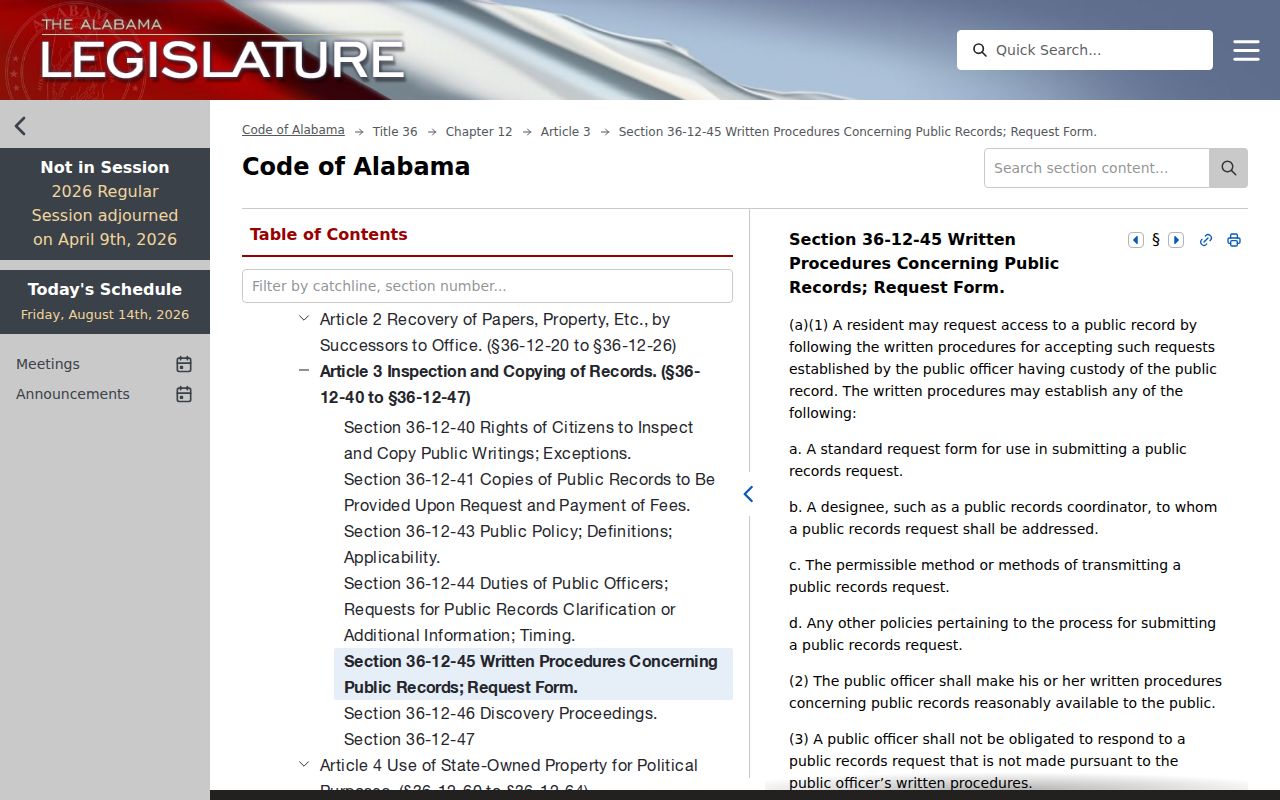
The law screen supports a narrow request strategy. Name the custodian, record type, date range, person or address, and preferred format. Ask about search and copy costs before work begins. Court records follow clerk and judicial rules rather than the executive-branch timetable.
The Tuscaloosa County Commission's general form covers only Commission-held records and must be submitted in person at 714 Greensboro Avenue, Suite G78. It is not a substitute for Probate, Assessor, or court channels. Commission estimates over eight staff hours require prepayment, and unsolicited email requests are not acknowledged.
Recent preservation work adds useful context. In fiscal 2025, state records-management archivists met with both city and county officials, while local volunteers continued the 602-volume 7th Floor Records Project. The 2025 Alabama Digital Markers Project also brought 218 markers from Tuscaloosa and two other counties into a new map. A record missing from the modern name portal may still survive in a bound volume, microfilm roll, or staff-assisted collection.
Note: Public access never authorizes stalking, threats, harassment, impersonation, or attempts to defeat a protected-address rule.