
Tuscaloosa Directory Collections by Era
Tuscaloosa city directories survive in several forms rather than one seamless online run. The Alabama Department of Archives and History inventory identifies early microfilm, selected bound issues, joint Tuscaloosa and Northport titles, and later county volumes. Tuscaloosa Public Library holds local directories and pairs them with newspapers, yearbooks, cemetery files, and funeral material. Digital items add page-level access for a few years, while staff-assisted shelves fill much of the gap.
| Collection | Years represented | Where held | Access route |
|---|---|---|---|
| Tuscaloosa city directory microfilm | 1913-1932 | Alabama Archives | Research room; local library holdings also help |
| Selected Tuscaloosa volumes | 1913-1973, with gaps | Alabama Archives and TPL | Physical volumes or staff-assisted access |
| Tuscaloosa and Northport titles | 1974-1997, with gaps | Alabama Archives and TPL | Physical collection |
| Tuscaloosa County volumes | 1999-2003 | Alabama Archives inventory | Physical collection |
| Polk directory page | 1922 sample | Alabama Memory | Free digital image |
| Telephone directory reel | November 1947-December 1953 | Library of Congress | Digital images, text, and PDF |
The listed years are not a promise of a volume for every year. Confirm the exact issue and format before a visit. A missing year may require the nearest city directory, a census schedule, or a dated newspaper. The Alabama Archives city-directory inventory is the precise starting list, while the library can confirm its own copy or film.
Tuscaloosa Directory Research Upstairs
The Tuscaloosa Public Library Archives and Genealogy collection is a working research room, not just a catalog entry. At the Main Library on Jack Warner Parkway, visitors sign in at the second-floor Reference Desk. Staff control access to archives and microfiche. A separate code opens the genealogy computers, including in-library resources and the library's FamilySearch affiliate access.
Bring a small list of names, spellings, addresses, and target years. Ask which directory issue is closest to the event. Black-and-white printing costs ten cents per page and color printing costs one dollar, so record title, year, page, and key before printing. Reference staff can be reached at 205-345-5820 ext. 1271 or info@tuscaloosa-library.org. Nonlocal researchers should ask what limited reference help is possible before arranging a paid archive search elsewhere.
The library reference page shows the service behind the collection.
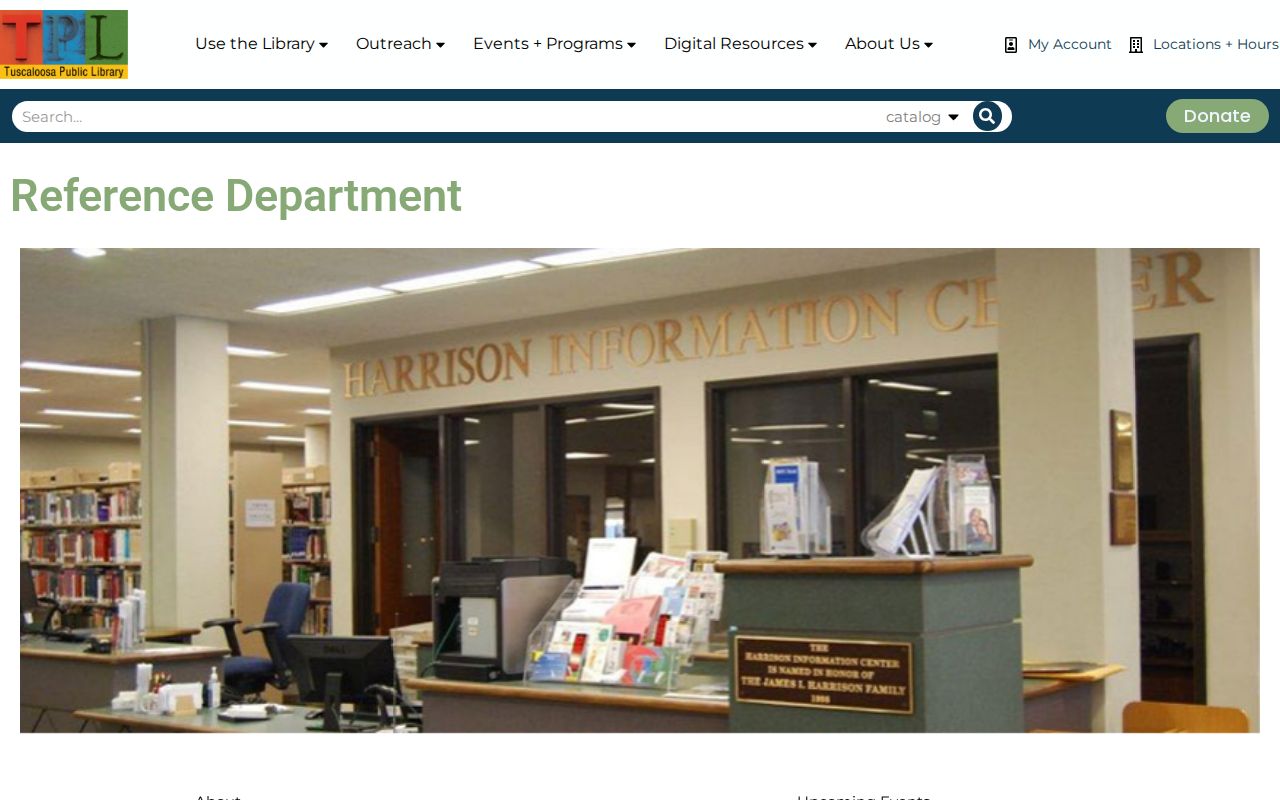
This screen points readers to the local staff who can confirm years, formats, and access before a Tuscaloosa directory visit.
Note: Ask for the exact year first because the library names its formats and subjects but does not publish a complete issue-by-issue run.
Decode a Tuscaloosa Directory Entry
A 1922 R. L. Polk page shows how much detail can fit in one short line. Entries are alphabetical and may give a spouse in parentheses, a work tie, an occupation code, and a residence. Several separately alphabetized people at the same address can reveal a household cluster. The words and marks still need that volume's own key. Do not assign a meaning to a symbol from a different edition.
| Name line | Surname with given name or initials; test spelling and initial variants |
|---|---|
| Spouse | Often appears in parentheses after the listed person |
| Work clue | An occupation abbreviation, firm, railroad, shop, or other association |
| Address mark | h marks house or home; r marks residence or rooms on the inspected page |
| Widow form | wid followed by a spouse's name can open an obituary or probate trail |
| Repeated text | same carries forward the preceding work or residence address |
- Criss-cross directory
- A later address-first or street-order section used to find the listed name at a known place.
- Householder index
- An index that organizes a directory around a household name or address instead of a full name search.
- Abbreviation key
- The publisher's legend for codes used in that issue. Capture it before interpreting a line.
The Alabama Memory 1922 Polk item provides an inspected Tuscaloosa city directory page.
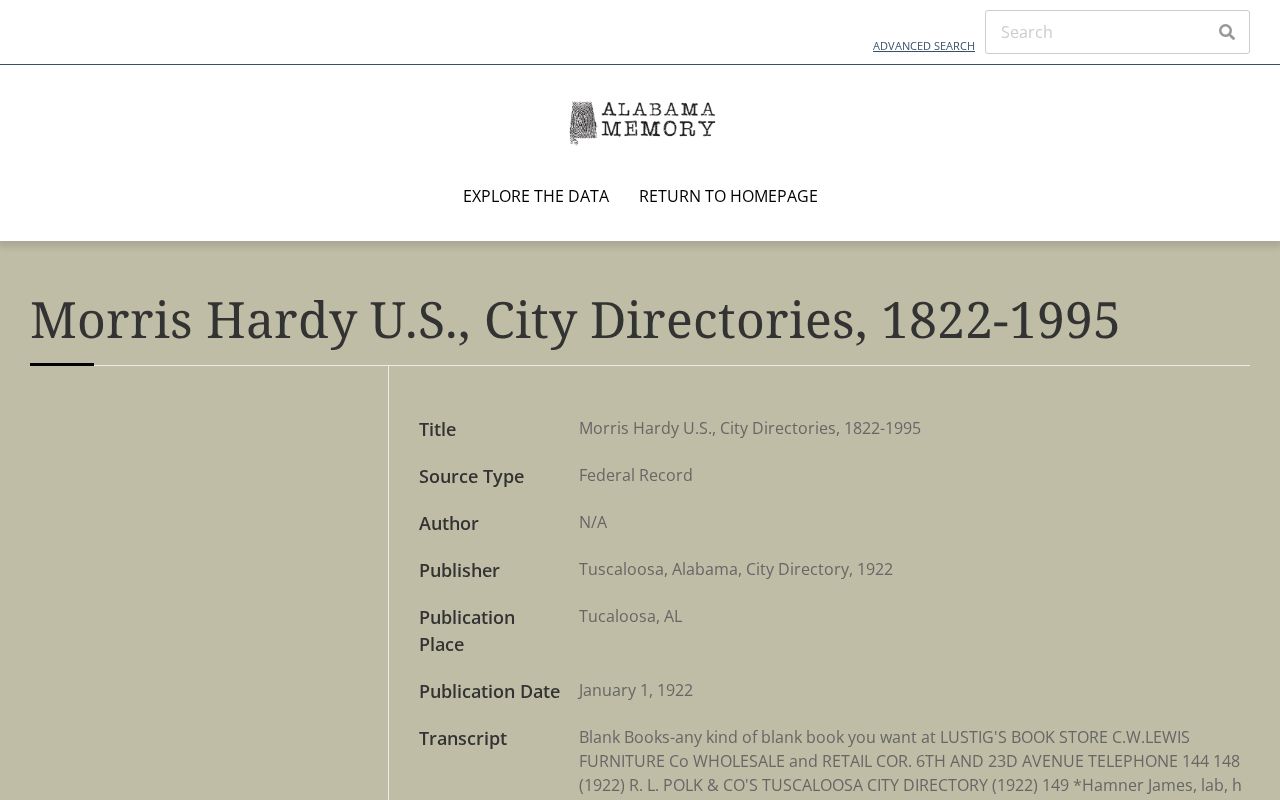
The image makes the compact codes, repeated addresses, and mixed personal and commercial entries easier to understand than a modern name index.
Tuscaloosa Directory Titles Shift
A useful local quirk appears on the spines. The series moves from Tuscaloosa-only volumes to Tuscaloosa and Northport in 1974, then to Tuscaloosa County titles by 1999. That change matters when a name seems to vanish. The resident may appear under a broader title even though the person or address stayed within the same connected urban area.
Search the title as well as the surname. A catalog query limited to “Tuscaloosa city directory” can miss a joint or county-branded issue. This is also a warning about present-day boundaries. Older geographic wording may not match modern city limits, neighborhood names, or postal conventions.
Tuscaloosa Directory Digital Companions
One directory line becomes stronger when it agrees with an independent record. The Tuscaloosa Circuit Court loose-record index covers 1889-1916 and 1923-1950. Its entries can include complainant, respondent, case type, date, case number, and related names. Those fields may connect a person to a family, estate, or dispute without treating the index as the complete file.
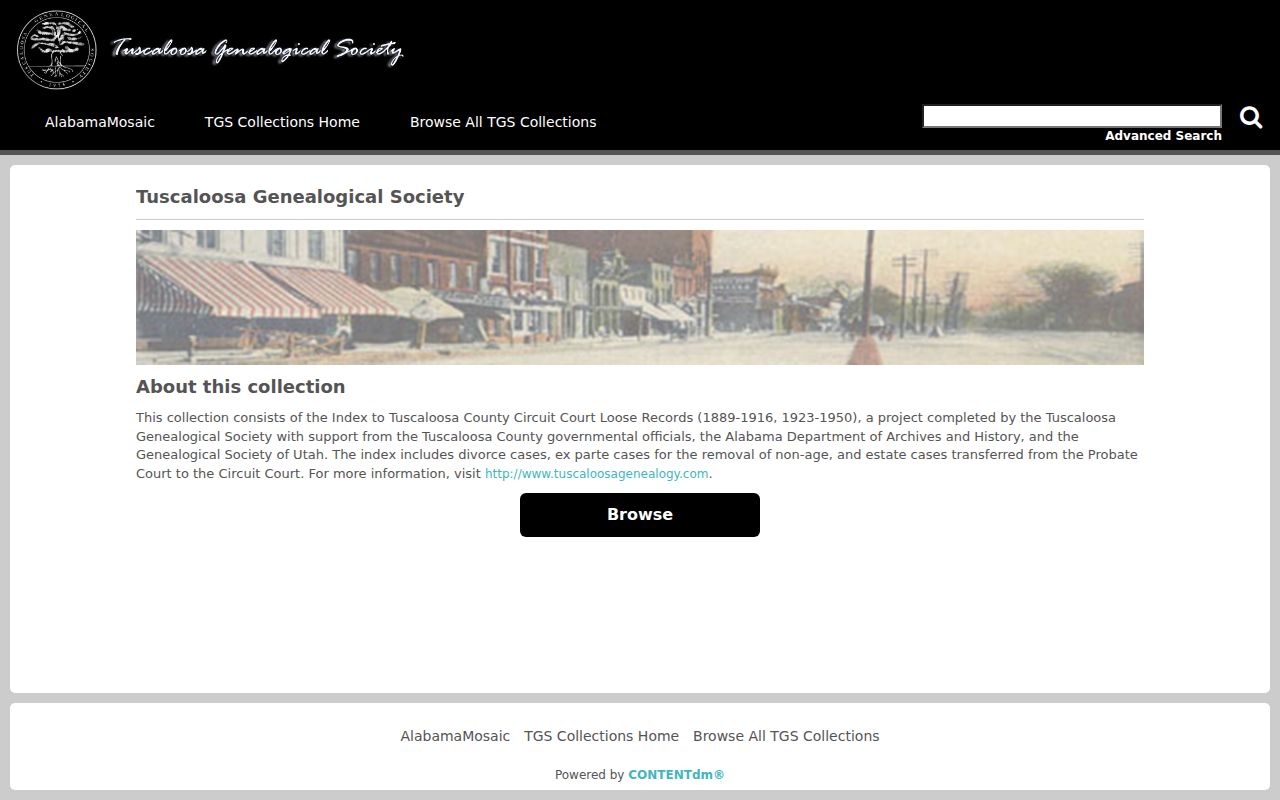
The digital collection adds named relationships and dated court context when a directory entry alone cannot distinguish two people.
The Library of Congress Tuscaloosa telephone reel is narrower. It covers subscribers and businesses shown in the white and yellow pages, not every household. Compare its 1947-1953 pages with Polk issues, newspapers, and the 1950 census. Agreement across sources is useful; disagreement should stay in the notes rather than be forced into one identity.
Map Tuscaloosa Directory Addresses
Sanborn fire-insurance maps help test whether an old house number referred to the same site. The verified Tuscaloosa run has six editions: 1884, 1889, 1894, 1899, 1905, and 1910. Sheet counts rise from four to twenty-six, a visible record of mapped growth. The maps show footprints, construction, height or use, streets, property lines, house or block numbers, mains, hydrants, and fire-alarm boxes.
Start with the directory's exact street wording. Find the nearest map edition, then compare the number, block, footprint, and adjoining streets. A modern number should never be projected backward without that check. The 1899 set has seventeen public-domain sheets online, and the University of Alabama inventory confirms the wider six-edition run.
Note: A mapped building supports address continuity, while the city directory supplies the dated person or firm associated with that address.
Tuscaloosa's Attic Index Story
Volunteers expected loose Circuit Court files from 1923 through 1950. They instead found earlier cases in a courthouse attic. The recovered 1889-1916 groups received A and B case prefixes, and the project took more than 2,350 volunteer hours. That preservation story explains why a modern portal cutoff is not the same as a record-loss date.
The same point applies to 602 bound courthouse books dated 1822-1961 in the Tuscaloosa Genealogical Society's 7th Floor Records Project. As of February 1, 2025, 292 were indexed. Pre-1840 books have page links; later books require reading a volume index, noting an image number, then opening the matching gallery. Historic search often has more steps because the old material survives in its original structure.
Trace Tuscaloosa Families Across Years
Family history works best as a sequence. Begin with the closest known year, preserve the entry as printed, and move one available issue at a time. A first appearance may suggest arrival, while a changed address marks a move. Disappearance alone proves neither death nor departure. It triggers a check of nearby issues, newspapers, funeral records, cemetery files, and probate.
- Search the surname, then initials, spouse, and spelling variants in the closest Tuscaloosa directory year.
- Transcribe the whole line, including codes, work tie, address, and page number.
- Check all people at the same address and use the street-order section when the issue has one.
- Move to the next available issue and log appearances, moves, widow notation, and gaps.
- Pair 1910, 1920, 1930, 1940, or 1950 census households with the nearest directory issue.
- Use Tuscaloosa News, cemetery, funeral, or probate material when the trail ends.
TPL yearbooks add a former-classmate route by school and year. University of Alabama special collections add finding aids for family papers, directories, yearbooks, church records, minutes, and address lists. These collections may identify a container rather than place the item online, so confirm reading-room rules before travel.
Tuscaloosa Directory Research Timeline
Tuscaloosa records reach well beyond the printed directory shelf. A compact timeline helps choose the next source when the needed directory issue does not exist.
| Date | Research milestone |
|---|---|
| 1818 | Tuscaloosa County was created before Alabama statehood. |
| 1819 | Tuscaloosa incorporated. |
| 1831 | The University of Alabama opened, creating a lasting institutional record stream. |
| 1913 | The verified early Tuscaloosa directory microfilm run begins. |
| 1974 | Listed titles begin naming Tuscaloosa and Northport together. |
| 1999 | The verified inventory shifts to county-branded volumes. |
| 2003 | The listed county directory run ends. |
For a modern address-first question, the Tuscaloosa street directory workflow uses parcel and deed tools. Historical city directory work should remain tied to the issue date and the publisher's own key.